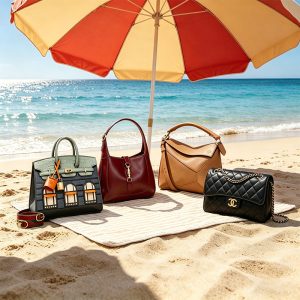
Saffiano is a leather finishing technique characterized by a fine crosshatch embossing pattern and a protective surface coating. It describes the material’s surface appearance and finishing effect—not the type of material itself. The substrate may be full-grain or split leather, or synthetic materials such as PU or PVC. As a result, materials labeled “Saffiano” may be genuine leather or synthetic leather, with differences in hand feel and durability.
For leather handbag OEM orders, buyers should look beyond whether the material has a Saffiano pattern. It is essential to verify both the substrate type and the quality of the surface finish, as these factors directly affect the hand feel, durability, and market positioning of Saffiano bags.
Ⅰ. The Origins and Manufacturing Process of Saffiano
1. Origins
The Saffiano finish is commonly traced back to 1913, when Mario Prada developed and patented the technique. It was originally applied to high-quality calfskin: a crosshatch pattern was hot-embossed into the leather, followed by a protective resin coating. This treatment made the leather more resistant to everyday scratches and water while helping it retain a structured shape. After the patent expired, Saffiano evolved into a widely used category of surface finishing. Manufacturers now vary in their substrate selection, coating formulations, and embossing precision, all of which affect the finished material’s hand feel, durability, and appearance consistency.
2. How the Saffiano Surface Is Created
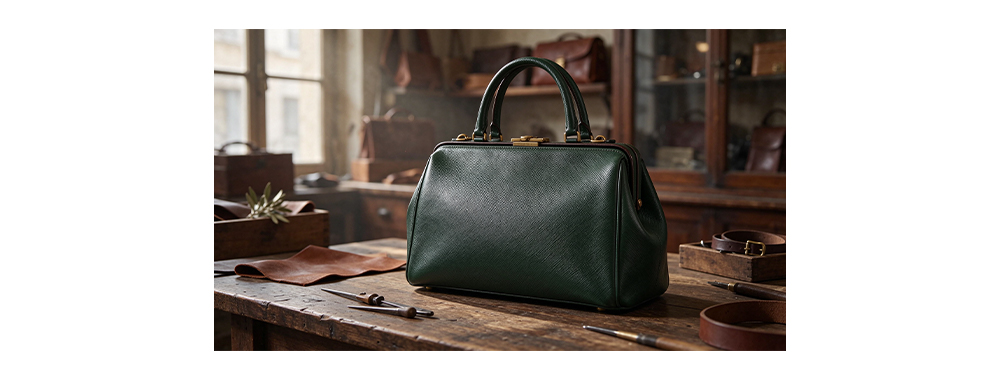
Saffiano finishing centers on two key processes: the formulation of the topcoat and the heat-press embossing process. The substrate may be genuine leather or a synthetic material, and the pretreatment methods differ considerably. Although the overall finishing concept is similar, embossing parameters, resin formulations, and adhesion systems are not identical. The process can be summarized as follows:
| Process Stage | Operation | Impact on the Finished Material |
| Substrate preparation | Genuine leather: hide selection, tanning, and base-color dyeing. Synthetic material: fabric-base pretreatment and resin lamination. | Determines the material’s basic strength, elongation, and hand feel. The substrate type also determines the final cost and product positioning. |
| Primer application | Apply an adhesive layer and base color to seal the substrate’s pores. | Improves topcoat adhesion, creates an even base color, and helps maintain clear, stable embossing. |
| Topcoat application | Apply a specialty wax-modified resin topcoat. | A key factor in Saffiano performance, affecting scratch resistance, surface sheen, and water repellency. |
| Heat-press embossing | Before the topcoat fully cures, use a heated metal plate to press the crosshatch ridges into the surface. | Forms the signature fine-grained texture in one operation and determines pattern definition and durability. |
| Post-finishing | Cure and polish the surface; optional color-wiping can create a two-tone effect. | For two-tone finishes, recessed areas retain a darker shade while raised ridges are wiped lighter. With extended friction, raised areas on two-tone finishes are more likely to show wear. |
The process shows that Saffiano’s distinctive appearance mainly comes from the embossing plate design and coating formulation. The clearer the pattern and the more evenly the coating is applied, the more consistent the finished surface will be. Because embossing and coating cover the substrate, the finish can also mask some natural surface imperfections, helping materials of different grades achieve a relatively uniform appearance.
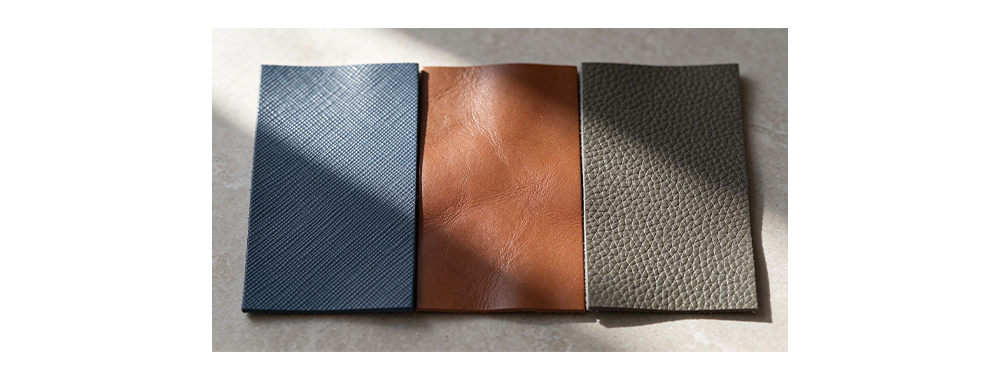
3. Saffiano vs. Smooth Leather and Pebbled Leather
Saffiano is often compared with conventional smooth leather and pebbled leather. Their main differences are outlined below:
| Comparison | Saffiano | Smooth Leather | Pebbled Leather |
| Surface texture | Fine crosshatch pattern | Smooth, with the natural grain retained | Irregular raised pebble-like grain |
| Surface finish | Embossing plus a wax-modified resin topcoat; subtle matte sheen | Usually a thinner coating or no heavy topcoat | Primarily embossed; coating thickness varies |
| Structure and firmness | Relatively firm; holds its shape well | Depends on the substrate; generally softer | Medium; depends on the substrate and embossing depth |
| Scratch resistance | Good; the texture helps distribute contact stress | Moderate; scratches are more likely to remain visible | Good; the grain structure provides some cushioning |
| Typical applications | Structured handbags, business bags, and wallets | Soft handbags and classic styles | Casual bags and vintage-inspired styles |
The right finish depends on the bag’s positioning, style, and intended use. Saffiano offers structure, scratch resistance, and easy care, making it suitable for structured bags that need to retain their shape. Smooth leather emphasizes the softness and sheen of natural leather, while pebbled leather adds visual and tactile depth to casual styles.
Ⅱ. Appearance and Performance Characteristics of Saffiano
1. Appearance
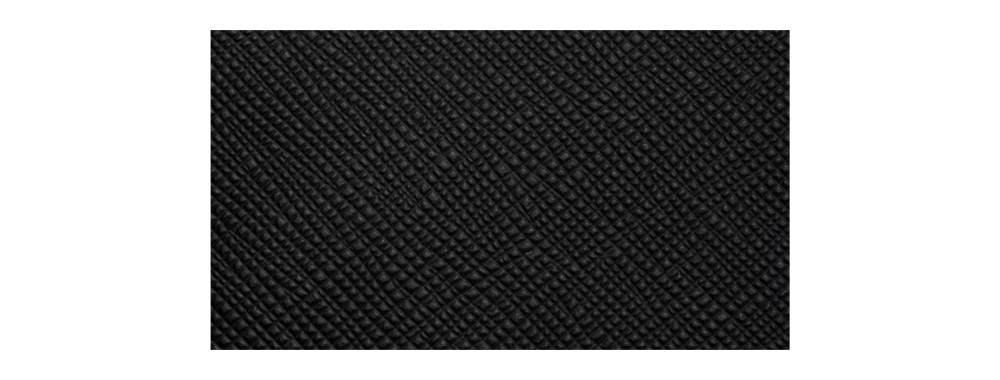
The most recognizable feature of Saffiano is its uniform, fine crosshatch pattern. This texture is not naturally occurring; it is embossed onto the leather surface using a patterned plate. Its depth, density, and direction can therefore be adjusted through plate design. The surface typically has a subtle matte sheen rather than a glossy, mirror-like finish, creating a restrained, orderly, and business-oriented look. Some Saffiano products use a two-tone color-wiping effect, in which raised areas appear lighter and recessed areas remain darker to create dimensional depth. This is a deliberate finishing effect, but the raised ridges may show wear sooner after prolonged friction.
2. Performance Advantages
Saffiano offers several practical performance benefits in bag applications:
• Scratch resistance: The raised crosshatch structure helps distribute external contact stress, making light everyday friction from fingernails, keys, and similar objects less likely to leave visible marks.
• Water repellency: The surface coating encourages water droplets to bead and roll off. Brief exposure to light rain or accidental splashes is less likely to result in immediate penetration.
• Easy care: Most stains remain on the coated surface and can be removed with a damp cloth, making routine maintenance relatively simple.
• Shape retention: Embossing and coating give Saffiano a relatively firm hand. Bags made from it can retain their shape when empty or carrying lighter items, making it suitable for handbags, briefcases, and wallets that require structure.
• Consistent appearance: Embossing and coating mask some natural variations in the substrate, making color and texture consistency easier to control in mass production.
3. Real-World Performance and Limitations
Saffiano performs differently depending on the use environment. The following points help buyers make a more informed assessment:
| Use Condition | Actual Performance | Points to Consider |
| Everyday scratches and abrasion | Performs well; generally more scratch-resistant than many uncoated leathers. | Severe abrasion or contact with sharp objects may still leave marks. |
| Brief exposure to rain or splashes | Water-repellent, but not waterproof. | Seams and zipper areas still require structural protection. |
| Contact with sharp objects | Can still be scratched or cut. | Not suitable as the primary material for demanding outdoor or tool-use applications. |
| Areas subject to repeated flexing | The coating may develop cracks over time. | Design flap hinges and strap attachment areas carefully. |
| Two-tone finish | Raised areas may lose color more quickly. | For long-term appearance consistency, consider a solid-color finish. |
Saffiano is not damage-proof. Rather, it is a material that is easier to maintain and keep looking presentable during everyday use. When describing its performance, brands should use accurate claims such as “scratch-resistant,” “easy to clean,” and “shape-retaining,” rather than absolute statements such as “scratch-proof” or “never wears out.”
Ⅲ. Genuine Leather Saffiano vs. Synthetic Saffiano
1. Why the Distinction Matters
“Saffiano” identifies a surface-finishing method, not the substrate. The market includes genuine Saffiano made with top-grain cowhide as well as synthetic Saffiano made with PU or PVC coatings on a textile backing. The two can look very similar, but they differ materially in hand feel, durability, how they age, and how they should be labeled. For brand material selection and product descriptions, identifying the substrate is essential to using the term “Saffiano” accurately.
2. Key Differences
| Comparison | Genuine Saffiano | Synthetic Saffiano (PU/PVC) |
| Substrate | Animal hide, usually cowhide | Polyurethane or polyvinyl chloride coating on a textile backing |
| Hand feel | Firm and substantial, with some softening over time | Generally lighter and softer, with more consistent hand feel |
| Durability | The coating tends to bond firmly to the leather; service life is generally longer under normal use | Can perform similarly at first, but coating delamination may be more likely after prolonged flexing |
| Aging | May become slightly softer and develop changes in sheen with use | Usually shows less visible change in appearance |
| Labeling | May be labeled “genuine leather,” “calfskin,” and so on | Should be identified as PU, PVC, or man-made material |
| Positioning | Mid-to-high-end through luxury | Mass-market through mid-range |
There is no simple, universal winner between genuine and synthetic Saffiano. The right choice depends on brand positioning, target retail price, intended use, and material claims.
For business bag lines that emphasize durability and material value, full-grain Saffiano is closer to what consumers generally expect from a leather bag. For product lines that prioritize color flexibility, price competitiveness, or a vegan positioning, synthetic Saffiano can meet those needs. The key is to ensure that the material name accurately reflects the actual composition.
Ⅳ. Bag Categories That Work Well with Saffiano
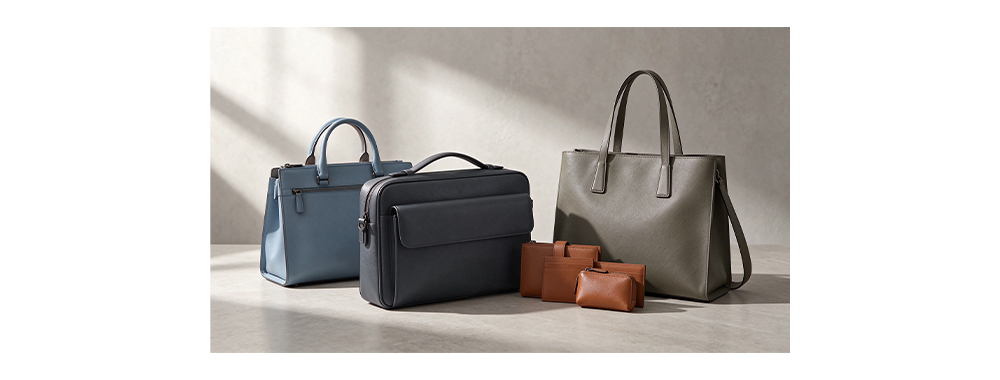
1. Categories with Strong Compatibility
Saffiano’s structure, scratch resistance, and easy-care properties make it particularly suitable for the following categories:
• Structured handbags: Their shape needs to be maintained, and they are often used for daily commuting. Saffiano’s firmness and scratch resistance are a good match.
• Business briefcases and laptop bags: Their neat appearance and easy-to-clean surface make them suitable for long-term use in business settings.
• Wallets and small leather goods: Frequent opening, closing, and friction place high demands on surface durability, giving Saffiano’s coated construction a practical advantage.
• Tote bags: Large panels need to retain their structure, and Saffiano can help maintain the silhouette when carrying relatively light items.
• Belt bags and crossbody bags: For everyday close-to-body use, scratch resistance and water repellency can reduce maintenance needs.
2. Categories That Require Careful Evaluation
Saffiano is not suitable for every type of bag. The following applications require careful assessment:
• Heavy-duty outdoor bags: Contact with sharp rocks or tools can still cause damage, so Saffiano is not recommended as the primary material for functional outdoor bags.
• Handbags designed for a soft, draped look: Saffiano is relatively firm and may not deliver the soft, fluid drape these styles require.
• Areas that flex frequently without reinforcement: Repeated flexing may increase the risk of coating cracks. Pattern engineering should include reinforcement or reduce continuous flexing where possible.
3. Common Applications in Custom Bag Development
In leather bag OEM/ODM projects, Saffiano is commonly used for the main body, flap, handles, and decorative trims, and it can also be combined with other materials. For example, Saffiano can be used on the main body to maintain structure, while canvas or nylon is used for the side panels or lining to reduce weight. Alternatively, genuine Saffiano can be used on the flap while synthetic Saffiano is used on the body to control cost. The key to material combinations is to ensure that each material’s properties support the bag’s overall function and positioning.
Ⅴ. Common Misconceptions and Everyday Care
1. Common Misconceptions
Misconception 1: Saffiano is always genuine leather.
Saffiano is the name of a surface finish. Its substrate may be genuine leather or a synthetic material. Check the product label and material specification rather than relying on the word “Saffiano” alone.
Misconception 2: Saffiano is completely waterproof.
Saffiano is water-repellent, not waterproof. It can handle brief splashes, but prolonged exposure to rain or immersion may still allow water to enter through seams, zippers, and other openings.
Misconception 3: Saffiano can never be scratched.
Saffiano resists light everyday abrasion relatively well, but sharp objects can still scratch it. Areas subject to repeated flexing may also develop coating cracks over time.
Misconception 4: The firmer the Saffiano, the better.
Firmness is one of Saffiano’s characteristics, but excessive stiffness may indicate an overly thick coating or a lower-grade substrate. The ideal hand feel is firm yet resilient—not simply as hard as possible.
2. Everyday Care Tips
Saffiano is relatively easy to maintain, but a few precautions are still important:
• Wipe the surface gently with a soft, damp cloth for routine cleaning. Avoid cleaners containing alcohol or strong solvents.
• Avoid prolonged exposure to direct sunlight or placement near heat sources, which may cause the coating to age or discolor.
• Do not store the bag under heavy objects for extended periods, as this may affect its shape.
• On two-tone Saffiano, raised areas may become lighter over time. This is a normal result of use; avoid excessive rubbing of the raised surface during care.
• Treat minor stains promptly with a damp cloth to prevent them from remaining in the recessed parts of the texture.
Ⅵ. Frequently Asked Questions (FAQ)
Q1. Why do Saffiano materials from different suppliers vary so much in hand feel and price?
A: “Saffiano” describes a surface finish and does not, by itself, define the substrate grade or manufacturing standard.
Differences in price and hand feel mainly come from three factors: (1) the substrate, such as full-grain cowhide, split leather, standard PU, or a microfiber backing; (2) the topcoat resin formulation and coating thickness—high-quality formulations balance scratch resistance with a firm hand feel, while low-cost coatings may feel excessively stiff or peel over time; and (3) the precision of the embossing plate.
When sourcing, buyers should specify both the substrate and the required coating performance to meet the target price point.
Q2. Which logo application methods work on Saffiano leather bags? Will the logo peel off?
A: Saffiano has a dense, subtly matte resin coating and a textured surface, so metal logo plates are generally the preferred option. The dense topcoat can make it difficult for standard screen-printing inks to adhere. If screen printing is required, use ink formulated for the coating and carry out appropriate surface pretreatment. In addition, wax-based topcoats may resist foil stamping, so the foil must be selected to match the surface.
Q3. Will the Saffiano coating age or turn yellow over time?
A: This depends on the quality of the resin formulation and storage conditions. High-quality Saffiano finishes generally offer good UV and oxidation resistance and are less likely to show obvious aging or yellowing under normal indoor use and proper storage. However, prolonged exposure to direct sunlight or high temperatures can accelerate the aging of any resin coating. For light-colored bags, use light-protective packaging and appropriate warehouse storage practices.
Q4. For a new bag collection, should a brand choose genuine Saffiano or synthetic Saffiano?
A: The choice depends on the brand’s pricing strategy and positioning. Full-grain cowhide Saffiano offers a premium appearance and better durability, making it suitable for brands focused on classic, business, or affordable-luxury styles. High-quality synthetic Saffiano, such as PU or microfiber-based options, offers greater flexibility in color development and more controllable costs. It can also support vegan material claims, making it a practical option for a brand’s first-season trial order and helping reduce initial inventory and cash-flow pressure.
Conclusion
The value of Saffiano leather lies in its well-defined finishing process, which brings together the everyday benefits consumers notice most: scratch resistance, water repellency, easy cleaning, and shape retention. The key to understanding Saffiano is to remember that it describes a surface finish, not the substrate itself. Saffiano can be made from full-grain cowhide or synthetic materials, and each option serves different product positions and price segments.
As a leather goods manufacturer, we have extensive experience developing and producing bags with Saffiano and other materials. We understand how different substrates respond to finishing processes and how those differences affect the final appearance. If you would like to explore the use of Saffiano leather in a specific bag style or discuss a custom development project, share your target category and design direction with us. We will provide material recommendations and development options tailored to your needs.